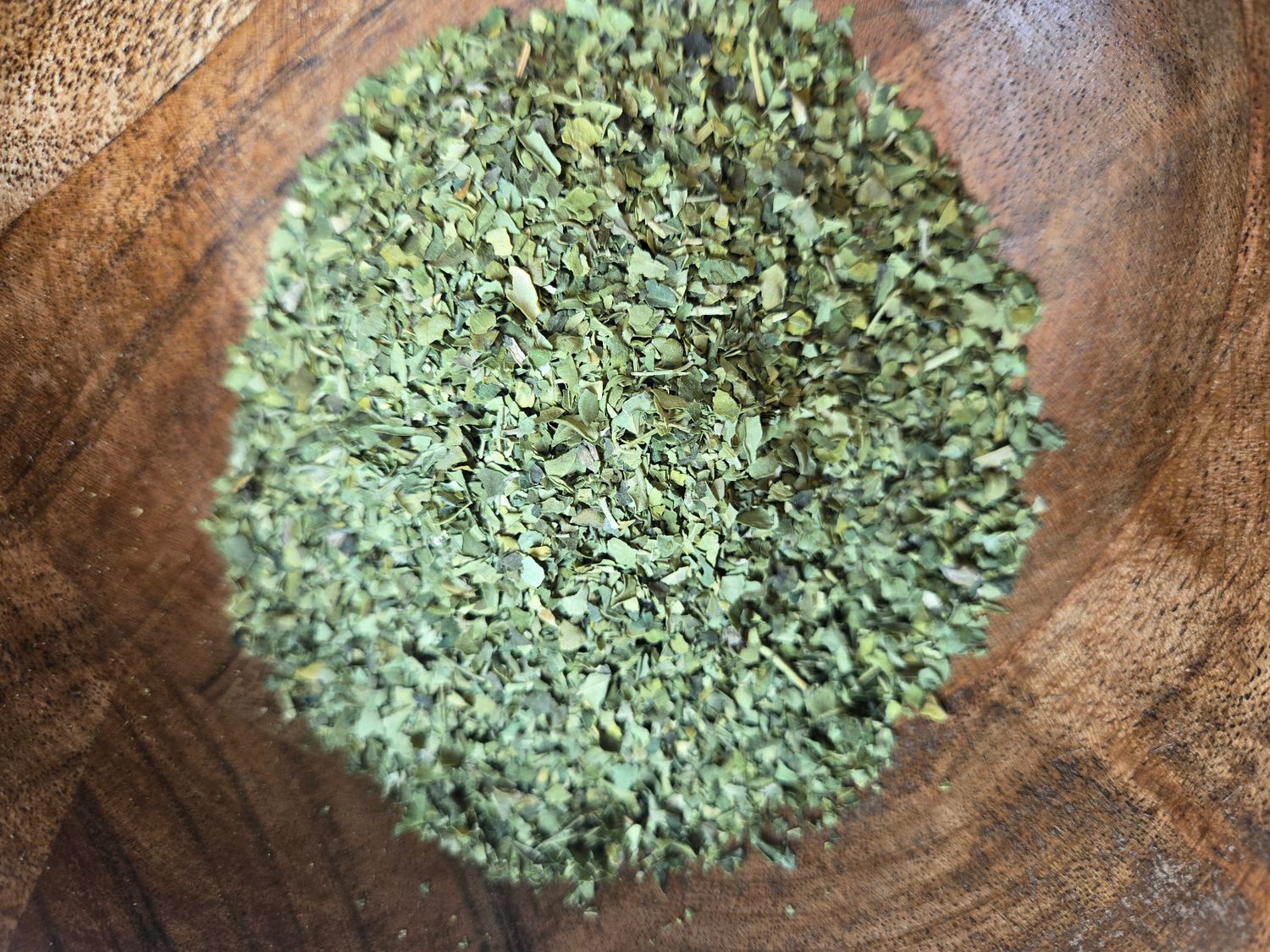
Moringa Leaves
$4.95
4 payments of $1.24 with
Options
Please choose
In stock
Save this product for later
Customer reviews
Reviews only from verified customers
No reviews yet. You can buy this product and be the first to leave a review.
Moringa Leaves
Product Details
🌿 Moringa Leaf (Moringa oleifera)
Also known as: Miracle Tree • Tree of Life • Drumstick Tree • Horseradish Tree
Botanical Name:Moringa oleifera
Family: Moringaceae
Part Used: Leaf
Primary Use: Internal • Culinary • Nutritional Tonic
Wellness Profile: Nourishing • Antioxidant-rich • Restorative • Traditionally anti-inflammatory
✨ Description
Few plants have earned a name as grand as “The Miracle Tree,” but Moringa has centuries of food and herbal tradition behind its reputation.
Moringa Leaf is a deeply nourishing green traditionally consumed as both food and herbal medicine throughout South Asia, Africa, the Caribbean, and other tropical regions. Rather than belonging to just one wellness category, Moringa is best understood as a whole-body nutritive tonic, making it especially useful when the goal is to nourish while supporting several body systems at once.
The leaves naturally contain protein, carotenoids, minerals, vitamins, polyphenols, flavonoids, and other antioxidant compounds. Research has particularly explored Moringa leaf for its antioxidant activity and potential effects on blood glucose and lipid metabolism, although human clinical evidence remains limited and Moringa should not be presented as a replacement for medical treatment.
Its earthy, green flavor makes Moringa easy to incorporate into teas, soups, smoothies, foods, and everyday wellness routines. For the herbalist, this is less of a “take it only when something is wrong” plant and more of a build, nourish, replenish, and maintain herb.
🌱 Traditional & Wellness Uses
🩸 Blood & Nutritional Support
Moringa Leaf has traditionally been valued as a nutrient-dense food, particularly where diets may be lacking in micronutrients.
It may complement a wellness routine focused on:
- Nutritional replenishment
- Healthy red blood cell production
- Iron and vitamin A intake
- Recovery from periods of poor nutrition
- General weakness and fatigue associated with inadequate dietary intake
Research on Moringa supplementation and nutritional status is promising but mixed, and its nutrient content varies substantially according to growing conditions and processing.
🍬 Blood Sugar & Metabolic Wellness
Moringa Leaf has a particularly interesting traditional reputation for metabolic health.
Small human studies of whole Moringa leaf powder have reported effects on blood glucose and blood lipids, but the evidence is not yet strong enough to consider Moringa a treatment for diabetes or high cholesterol.
For your website, I would position this as:
“Supports healthy glucose and lipid metabolism as part of a balanced wellness routine.”
❤️ Heart & Circulation
Moringa's antioxidant-rich leaves make it a natural fit within a cardiovascular wellness routine.
Traditionally and experimentally, the plant has been investigated for:
- Healthy cholesterol and lipid metabolism
- Antioxidant protection
- Healthy circulation
- Cardiovascular wellness
- Supporting a healthy inflammatory response
Much of the cardiovascular research beyond glucose and lipid effects remains preclinical, so “heart support” is more accurate than promising treatment of cardiovascular disease.
🔥 Inflammation & Antioxidant Support
Moringa contains numerous bioactive compounds, including flavonoids, phenolic compounds and glucosinolates.
These compounds are among the reasons Moringa has attracted significant research interest for antioxidant and inflammatory pathways.
This makes Moringa a beautiful companion to Turmeric, Ginger, Nettle, or Burdock in general wellness routines.
🌿 Digestive & Liver Wellness
Moringa has a long history of traditional medicinal use, including applications involving digestion and the liver.
Rather than describing Moringa as a harsh “detox,” I prefer to think of the leaf as nutritive support during cleansing. It gives the body plant nutrition while herbs such as Dandelion, Burdock, or Yellow Dock provide more targeted bitter and elimination support.
🛡️ Immune & Everyday Wellness
Traditional systems have also used Moringa as an immune-supporting food and medicine. Its combination of plant nutrients and antioxidant compounds makes it particularly suited to daily nourishment rather than aggressive immune stimulation.
🌴 Caribbean & Cultural Significance
Moringa originated in South Asia but traveled exceptionally well. Today it grows throughout tropical and subtropical regions and has become an important food and traditional wellness plant in Africa, Central and South America, Mexico, the Caribbean, and throughout Asia.
Across Caribbean communities, Moringa is commonly known simply as Moringa or the Miracle Tree and is used as both food and bush medicine.
The leaves may be brewed into tea, powdered into drinks, cooked similarly to other leafy greens, or incorporated into tonics. It is especially appreciated as a strength-building and nourishing plant rather than merely a cleansing herb.
This is part of what makes Moringa so special within Caribbean herbalism. It represents the intersection between food and medicine. You don't necessarily have to be sick to have a reason to use it.
🍵 How to Use
Moringa Leaf Tea
Add 1–2 teaspoons of dried Moringa Leaf to 8 oz of hot water.
Cover and steep for approximately 10–15 minutes, strain, and enjoy.
Drink 1–2 cups daily as desired.
Its naturally green, earthy flavor pairs particularly well with:
- Peppermint
- Ginger
- Cinnamon
- Lemongrass
- Hibiscus
- Soursop Leaf
As a Daily Wellness Herb
Moringa can also be incorporated into soups, broths, herbal blends, and other foods for additional plant-based nourishment.
🌿 Pairing Suggestions
Moringa + Nettle Leaf
For mineral-rich nutritional and blood support.
Moringa + Yellow Dock + Burdock
For a more traditional blood-building and cleansing combination.
Moringa + Cinnamon + Fenugreek
For metabolic and blood-sugar wellness support.
Moringa + Turmeric + Ginger
For antioxidant, inflammatory, digestive, and circulatory support.
Moringa + Sea Moss
For a broad-spectrum plant and mineral wellness combination.
⚖️ Energetics & Taste
Taste: Green • Vegetal • Mildly bitter • Earthy
Energetic Profile: Nourishing • Restorative • Slightly cooling
Herbal Role: Nutritive tonic
Moringa is particularly appropriate for people who want an herb that adds nourishment rather than simply removing or stimulating something.
🔮 Metaphysical & Energetic Uses
A tree that can thrive in difficult climates while continually producing nourishing leaves naturally became associated with:
- Resilience
- Abundance
- Vitality
- Protection
- Growth
- Restoration
Moringa carries the energy of having enough to give without becoming depleted.
Affirmation:
“I am nourished at my roots. My body has what it needs to grow, restore, and thrive.”
⚠️ Warnings & Considerations
Moringa leaf has a history of food use and available human studies of leaf preparations have generally reported good tolerability. However, medicinal-dose research remains limited.
Consult your doctor or herbalist before medicinal use if you:
- Take medication for diabetes or blood sugar
- Take blood-pressure medication
- Take thyroid medication
- Are pregnant, trying to conceive, or breastfeeding
- Take multiple prescription medications
The root, bark, flowers, seeds, and concentrated extracts should not automatically be treated as interchangeable with Moringa leaf. Different plant parts have different chemistry and safety considerations.
🌻 A Note from the Herbalist
Moringa is one of those herbs I consider food and medicine at the same time.
Some herbs have one job. Moringa refuses to stay in one category. I think of it when someone needs nourishment, minerals, antioxidant support, metabolic support, or simply something green they can incorporate consistently into their wellness routine.
That is where the name Miracle Tree makes sense to me. Not because Moringa magically cures everything, but because one humble leaf can offer the body so much.
I especially love pairing Moringa with other herbs according to what the person needs. Nettle and Yellow Dock when we're focusing on blood and nutrition. Cinnamon and Fenugreek for metabolic wellness. Turmeric and Ginger when inflammation is the concern.
Moringa doesn't have to be the loudest herb in the formula. Sometimes its job is simply to make sure the body is being fed while we're asking it to heal.
🏷️ Categories
Primary Categories
- Superfoods & Nutritional Herbs
- Blood Quality
- Iron & Nutritional Support
- Antioxidant Support
- Traditional Teas
Secondary Categories
- Blood Sugar Support
- Cholesterol & Heart Health
- Inflammation Support
- Immune Health
- Digestive Wellness
- Hair & Skin Wellness
- Women's Wellness
- Men's Wellness
- Caribbean Remedies
- Traditional Herbal Medicine
- Everyday Wellness
🔍 Wellness Keyword Phrases
- Moringa leaf benefits
- Moringa tea benefits
- Miracle Tree herb
- Nutrient-rich herbal tea
- Herbs for everyday wellness
- Herbs for blood and iron support
- Moringa for blood sugar support
- Moringa for cholesterol support
- Antioxidant-rich herbs
- Natural nutritional tonic
- Caribbean Moringa tea
- Caribbean bush medicine
- Herbs for energy and vitality
- Herbs for healthy aging
- Moringa for hair and skin
- Moringa wellness tea
- Traditional Moringa leaf
- Moringa oleifera leaf
SEO Keywords:
Moringa leaf, Moringa oleifera, Moringa tea, Miracle Tree, Moringa benefits, Caribbean Moringa, Moringa leaf tea, blood building herbs, iron support herbs, herbs for blood sugar, herbs for cholesterol, antioxidant herbs, nutritional herbs, superfood herbs, traditional Caribbean herbs, Island Roots Botanicals Moringa
Powered by Lightspeed
Display prices in:USD